Years ago, when I first came back to racing, I devoured every book I could find on racecraft. From the well-known Speed Secrets series by Ross Bentley to obscure independent publications like You Suck at Racing by Ian Korf, and everything in between. I have a whole shelf in my bookcase dedicated to this “research” as I sought to build speed as quickly as possible during my return.
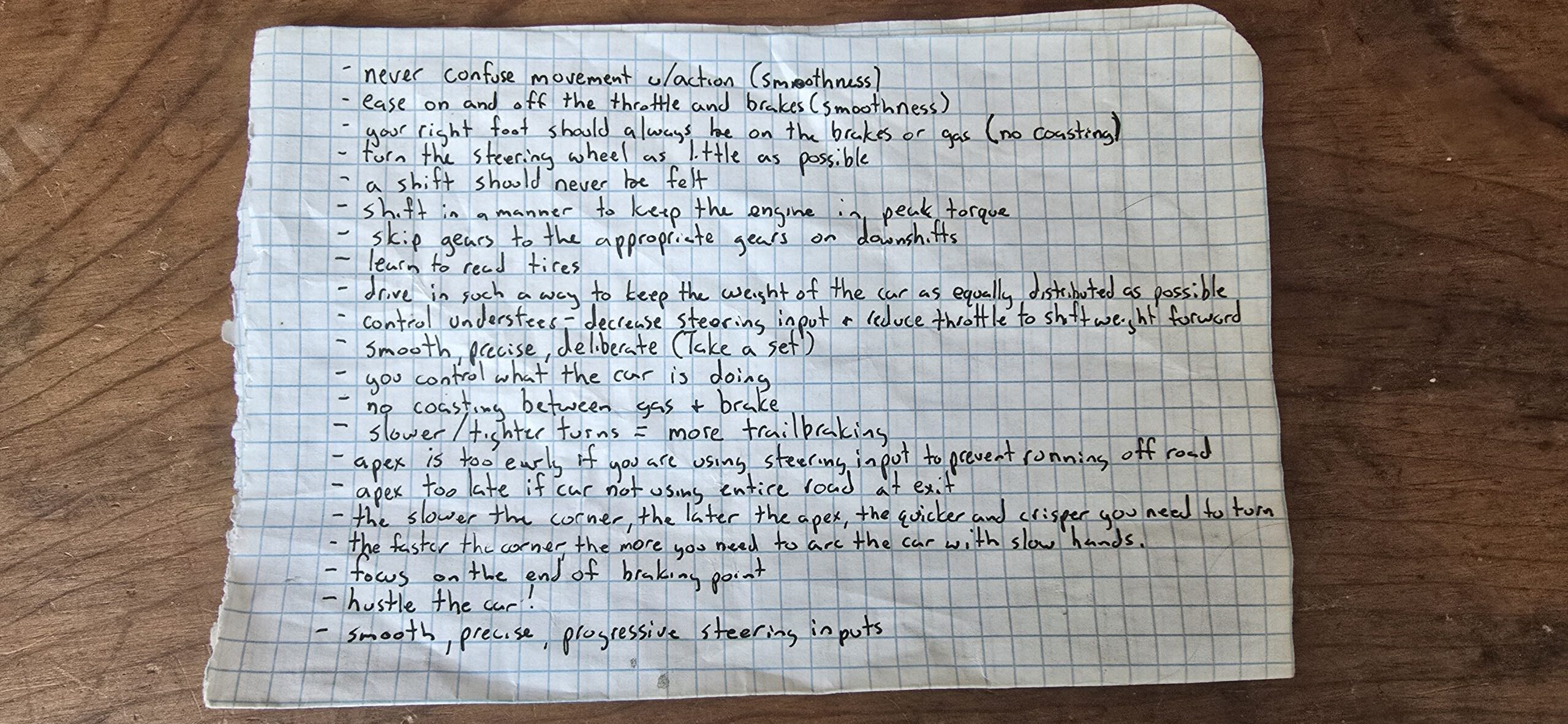
Which is why stumbling across my old refrigerator list, what I call The Fridge Rules, was such a cool find. This was a list I put together during that time to push myself forward. It contains a range of topics, all circling one theme: how to go faster at the racetrack. They were reminders, written for me, to attack the areas I knew I needed to improve.
Looking back now, it’s interesting to see how this early effort shaped my journey, helping me move from a mid-pack driver to running at the front. I’ve internalized and mastered each of these rules over time, but they remain just as relevant today. My hope is that this list may help other drivers. Especially those living in the vast expanse between novice and expert, searching for practical advice on how to take the next step.
The Fridge List
Here is the original list. In this article, I will discuss the ones that made the most significant difference for me, as well as insights from my current vantage point and maybe a rule or two that should be on the list.
Rule 1: Never Confuse Movement with Action
This was a big one for me to start. In drifting, big movements are the norm. You are constantly pitching the car sideways and keeping it there with exaggerated inputs. But that’s not the fastest way around a racetrack. So, I had some deprogramming to do right from the start.
When I first returned to racing, I tended to overdrive in one corner and then underdrive the next, almost as if I was trying to “force” speed with busy hands and feet. This simple statement helped me mentally connect my inputs to the car’s actual behavior. It quickly gave me a better sense of where the limit was and how to stay there without wasting effort.
But this rule is about more than just settling down behind the wheel. It’s about smoothness. The smooth driver, at the limit, has more grip available and uses less energy, both mechanical and mental. Smoothness is not passive. It’s the hallmark of control.
Rule 2: Turn the Steering Wheel as Little as Possible (to Get the Job Done)
This one sounds counterintuitive, but it’s fundamental: there’s only so much grip a car has to give. Steering, braking, and accelerating all draw from the same finite traction budget. Exceed the limit, and the car slides. The art of driving fast is living right at that edge, sometimes even nudging past it.
Focusing on minimizing hand inputs forces you to maximize foot inputs. In other words, the less you crank the wheel, the sooner you can get back to accelerating.
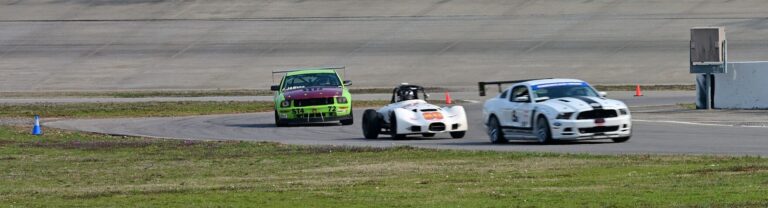
Take NOLA Motorsports Park as an example. In the technical three-turn complex before the back straight, I’d turn in earlier and slower than the rest of the field. Instead of “driving each corner,” I thought about how the sequence flowed — prioritizing the entry of the first turn and the exit of the last. The car stayed more stable, which meant I could pick up the throttle earlier. The result? A consistent 5 mph advantage at corner exit, translating into multiple car lengths by the end of the straight.
What felt to me like a natural progression took two full seasons for the competition to figure out. That’s the power of using less steering input to unlock more speed.
Rule 3: Your Right Foot Should Always be on the Brakes or Gas
It sounds simple, and it is: your right foot should never be idle. Yet I see drivers of all skill levels coast before braking, as if “waiting” for the next input. But this isn’t Formula 1, and no one’s on the radio telling you to save fuel. Coasting is wasted time. Every moment on track, you should be either accelerating or decelerating.
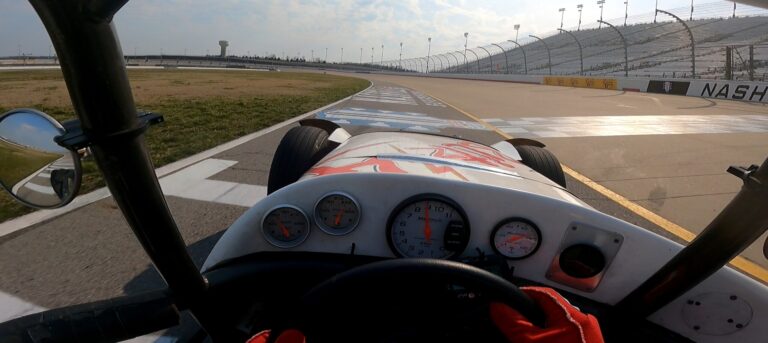
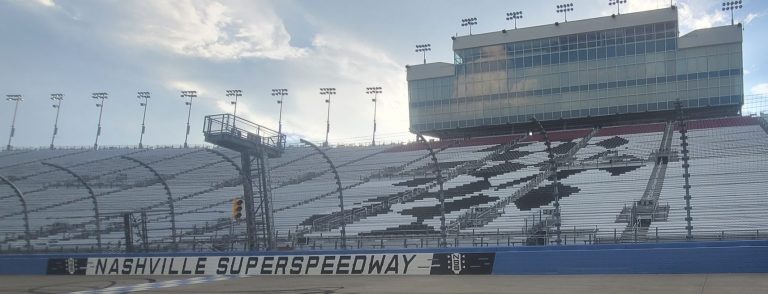
Even on long straights, there’s work to be done. At Nashville Superspeedway in the Thunder Roadster, approaching Turn 1 at 10,000 rpm in 5th gear, my right foot isn’t resting. I’m feeding in just enough maintenance throttle to keep the engine on the boil, right below fuel cut. That sliver of input matters, keeping the car balanced for the next input.
A lot of this bad habit, I believe, comes from how many HPDE groups teach novices. There’s a heavy emphasis on “the line” and on braking before turn-in, which makes sense early on. However, it naturally segments the sequence, braking, then turning, and many drivers start to segment everything accordingly. The result? They end up coasting between phases, leaving time on the table.
The cure is simple: keep your right foot busy. Brake or throttle, no coasting.
Rule 4: You Control What the Car is Doing
At some point in racing, you have to face a truth: the car isn’t unpredictable. You are.
Once it clicks that every slide, every understeer, every twitch is simply feedback from your own inputs, your driving shifts profoundly. You stop seeing the car as a wild animal to be tamed and start seeing it as an instrument responding to your hands and feet.
Conditions will always be dynamic. Grip changes, tires fade, setups are never perfect. But none of that excuses you from control. What you can control, always, is your composure and the quality of your inputs.
This realization is a letting go. You stop fighting the car, accept reality, and own the outcome. That’s when you cross a threshold: you become capable of driving anything fast.
Bonus: Drive Your Car, Not the Track
Here’s a truth I wish more drivers understood: in racing, there is no single “line.” You’re not driving the track, you’re driving your car on the track.
That means the textbook apex at turn 3 might not be the fastest way through in your car, with your setup, on this day. Yet I see drivers again and again steering toward the cone or paint mark as if it’s sacred, scrubbing speed when their car’s natural flow could have carried them through cleaner and faster.
This is where confidence and knowledge intersect. The “line” you were taught in HPDE is just a framework. Real speed comes when you start listening to your car and letting it dictate the line.
Are you in a momentum car that thrives on rolling speed? Then maybe the wider arc is faster. Are you in a torque monster that can square off the corner and rocket out? Then maybe the early apex is your friend.
There is no universal map. The fastest drivers know that the track doesn’t care what you were taught; it only rewards the driver who adapts their car to it. And that is one principle that sums up my whole list.
Conclusion
I chose to focus on the rules that stand out most in my mind, but every one of the fridge rules has its place in driver development. Even though they started as quick scribbles on a sheet of paper taped to my fridge, they became the framework for everything I’ve done in racing since. They’re not glamorous, but they’re the truth: simple principles, executed with discipline, will always make you faster.
If you’re somewhere between novice and expert, maybe it’s time to write your own fridge list.
Over the years, my list has evolved and deepened. What you see here was my starting point. And now it’s integrated into my driving like a reflex. This exercise reminded me just how much knowledge there is to share. Each of these rules deserves a deeper dive, and there are even more advanced topics to cover in the future.
The List
Here is the complete list for those struggling to decipher my handwriting.
- never confuse movement w/action (smoothness)
- ease on and off the throttle and brakes (smoothness)
- your right foot should always be on the brakes or gas (no coasting)
- turn the steering wheel as little as possible
- a shift should never be felt
- shift in a manner to keep the engine in peak torque
- skip gears to the appropriate gear on downshifts
- learn to read tires
- drive in such a way to keep the weight of the car as equally distributed as possible
- control understeer – decrease steering input and reduce throttle to shift weight forward
- smooth, precise, deliberate (Take a set)
- you control what the car is doing
- no coasting between gas and brake
- slower/tighter turns = more trail braking
- apex is too early if you are using steering input to prevent running off road
- apex is too late if the car is not using the entire road at exit
- the slower the corner, the later the apex, the quicker and crisper you need to turn
- the faster the corner the more you need to arc the car with slow hands
- focus on the end of the braking point
- hustle the car!
- smooth, precise, progressive steering inputs